UMD Researcher Helps Bring Regenerative Practices to Ukrainian Farmers
Large-scale agriculture is a pillar of the Ukrainian economy.
Image Credit: Courtesy: Ray Weil, University of Maryland
Supporting a country at war can mean more than supplying weapons and medical assistance. In Ukraine, support can mean helping farmers increase their harvests and improve their soils. University of Maryland soil scientist Ray Weil got a first-hand look at why that’s so important when he spent three weeks advising Ukrainian farmers on regenerative agriculture, cover crops, and soil health.
“It was a very different kind of trip for me,” said Weil, who has spent years doing farmer-to-farmer outreach throughout the U.S. and Africa. “Ukraine is unique not just because it is a country at war, but because its soils are famously rich and productive, and its history under the former Soviet regime has shaped the agricultural industry and culture.”
A large portion of the world’s most fertile black soil, ideal for growing crops, is found in Ukraine. The country is a leading supplier of the world’s wheat, corn, barley, and sunflower. Its economy relies heavily on these agricultural products, which account for more than 40% of Ukraine’s export earnings. But the war has damaged agricultural infrastructure and reduced the amount of land and people available for farming. Ukrainian farmers are eager to adapt by modernizing their farming methods, like buying the latest variable-rate precision application equipment, optimizing their operations, and increasing the productivity on the lands they farm.
Weil was there as part of an international team of agricultural experts to help with this effort. His goal was to show them how to evaluate and understand their soils, and to teach them conservation practices to protect their soils from erosion, and improve soil health and productivity.
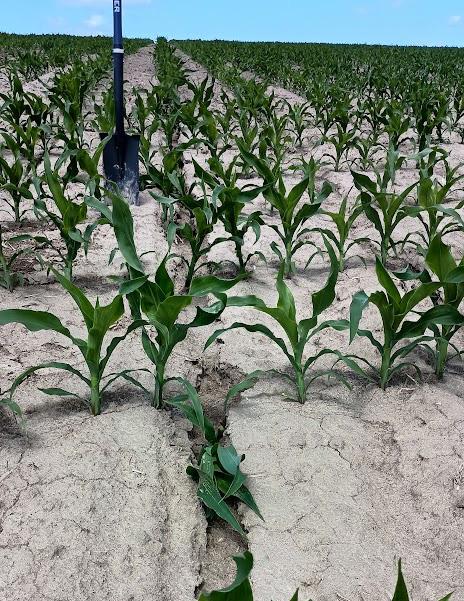
“This is a country with some of the world’s best soils, but they’ve also been degraded over the years from industrial farming practices, like large monoculture, aggressive tilling, and almost no use of cover crops,” Weil explained. “Their soils have suffered from erosion, compaction, and loss of organic matter. Regenerative farming recognizes that soils need to be covered as they are in nature, not left bare. Adoption of practices like strip-till or no-till and planting multi-species cover crops can protect the soil, add diversity, and return nutrients and carbon to the earth.”
These are practices that many Maryland farmers have embraced, and Weil has been sharing with farmers in the U.S. and around the world for many years. But they’re relatively new in Ukraine, which developed its agricultural sector under Soviet rule, in which farms were huge government-owned collectives with centralized, inflexible top-down management. The imprint of that system remains today.
“There was this juxtaposition of small, diverse “peasant” vegetable farms that fed local subsistence with industrial-scale commodity farms. The largest farming company we visited cropped more than a million acres of land, about as much cropland as in the entire state of Maryland!”
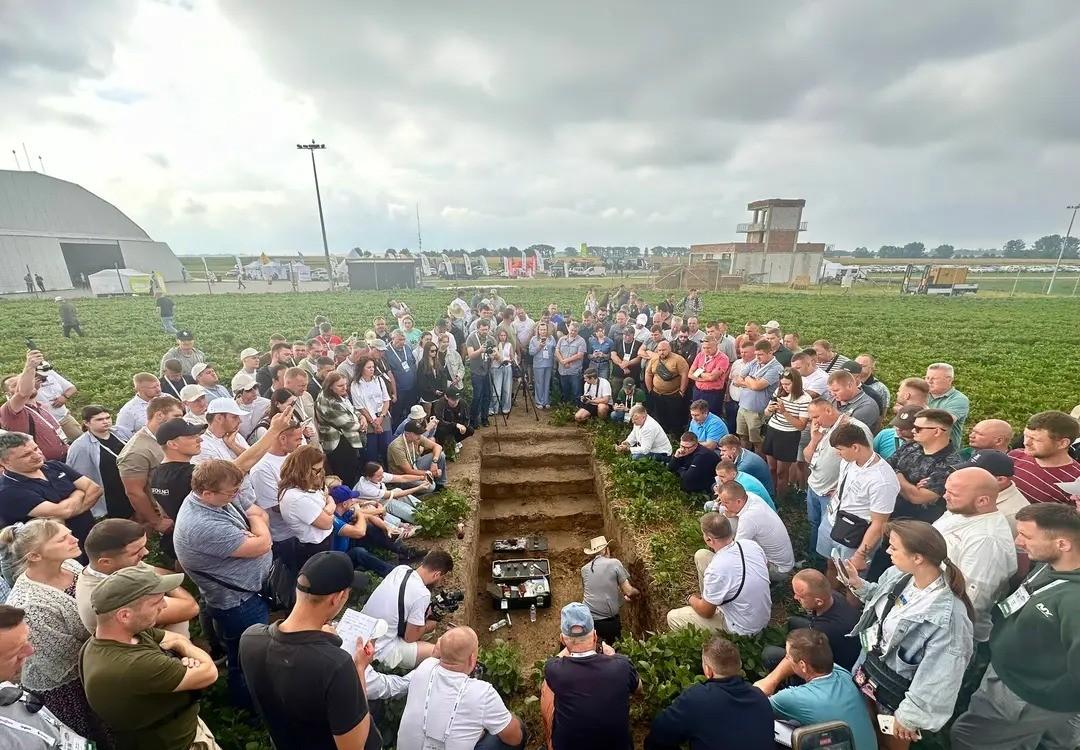
Weil toured 27 fields on a dozen farms across the country, sometimes sleeping to the sounds of anti-aircraft fire in the distance, or waking in the middle of the night to retreat to a bomb shelter. Despite the difficult conditions, dozens of farmers turned out for each of his “soil pit talks,” and hundreds then came to a two-day conference held at the end of the field tour.
In each location, the farmer excavated a soil pit in advance of Weil’s arrival, and he gave presentations on how to evaluate the soil, how current and past management had affected the soil profile characteristics, and suggested practices that could improve soil health, specifically on that farm.
“At the conference, I had hundreds of people around one pit,” he said. “I’d never experienced that before. There was so much interest.”
One distinctive feature of these talks was that his audience was mostly young and relatively new to farming, in part because older men tended to be on the front lines fighting while the young people stayed behind to run the economy (and have kids). Many were new to farming because private farm ownership is relatively new in Ukraine, with the ability to buy and sell farmland only established in 2019.
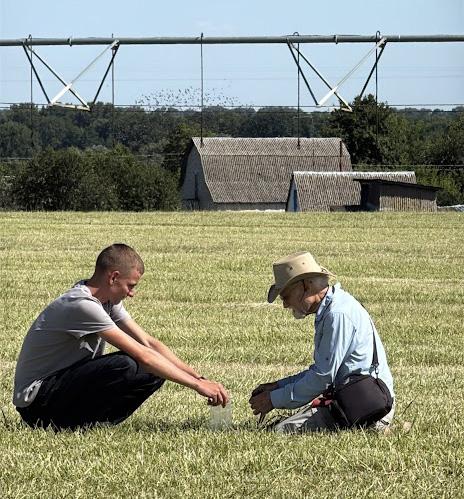
“Several young farmers proudly showed me photos on their phones of their fathers in the trenches defending the country. Many of these young farmers didn’t grow up on a farm, their fathers weren’t farmers. They’re new to it and eager to learn about new technologies and the best approaches to care for their soils. It was a very different experience for me.”
From the scale of the farms to the resilience of the people and the eagerness of the farmers, Ukraine made a significant impression on Weil, who has been keeping in touch with the people he met through regular Zoom calls. He is applying for grants to continue the work there and hopes to return to the country soon.
“To me, it was an application of knowledge that really has an impact on a variety of levels. Of course, they’re fighting a war and the benefits will help support their economy, and then they have this very rich soil that can be improved, and the farmers are really pretty inexperienced with regenerative practices and open to new ideas.” Weil said. “It was a real opportunity to put our science to use for good.”
