If I were to plot my weeks on a scale of fun, last week would have set a high bar. Between working with our CARETs and associate deans to make Hill visits, recognizing our student scholars, and visiting with donors and partners, it was a tough week to beat. Although I was admittedly quite tired by the end. Black tennis shoes will be my footwear of choice next year.
The conversations over the last couple of weeks have helped me better articulate how our AGNR priorities are interconnected to advance the college and our ability to better support Maryland agriculture and natural resources management. As always, feedback is welcome.
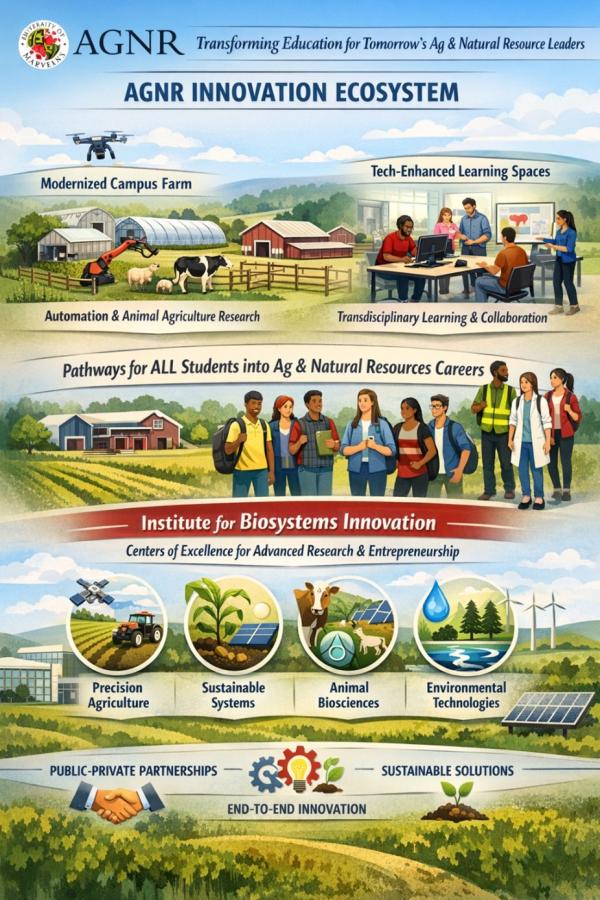
I like to visualize how concepts connect so I asked ChatGPT to generate an image using the language below. Here’s what it produced. Not bad, but I suspect our AGNR communications team can do better once we have things defined and designed.
"AGNR strives to transform our student experience to ensure a tech-savvy workforce by creating opportunities and spaces for transdisciplinary learning and engagement that build communication, problem solving, and critical thinking career skills that prepare our students to adapt and innovate throughout their career. In addition, AGNR is committed to creating pathways for non-AGNR students to find their place in agriculture and natural resource employment sectors. Modernization of the campus farm to serve as a development and demonstration site for automation and innovation in animal agriculture and natural resources management will provide the space to offer these opportunities to AGNR and non-AGNR students. New animal housing areas will expand current programming to include advanced technology research for animal husbandry and broader agriculture practices while simultaneously providing a creative environment for student learning and entrepreneurship. Building on this, an Institute for Biosystems Innovation comprised of multiple centers of excellence built on long-term public-private partnerships creates the environment necessary for end-to-end innovation that ensures needs are accurately identified and developed solutions are feasibly implemented thus advancing profitable, sustainable agricultural systems."