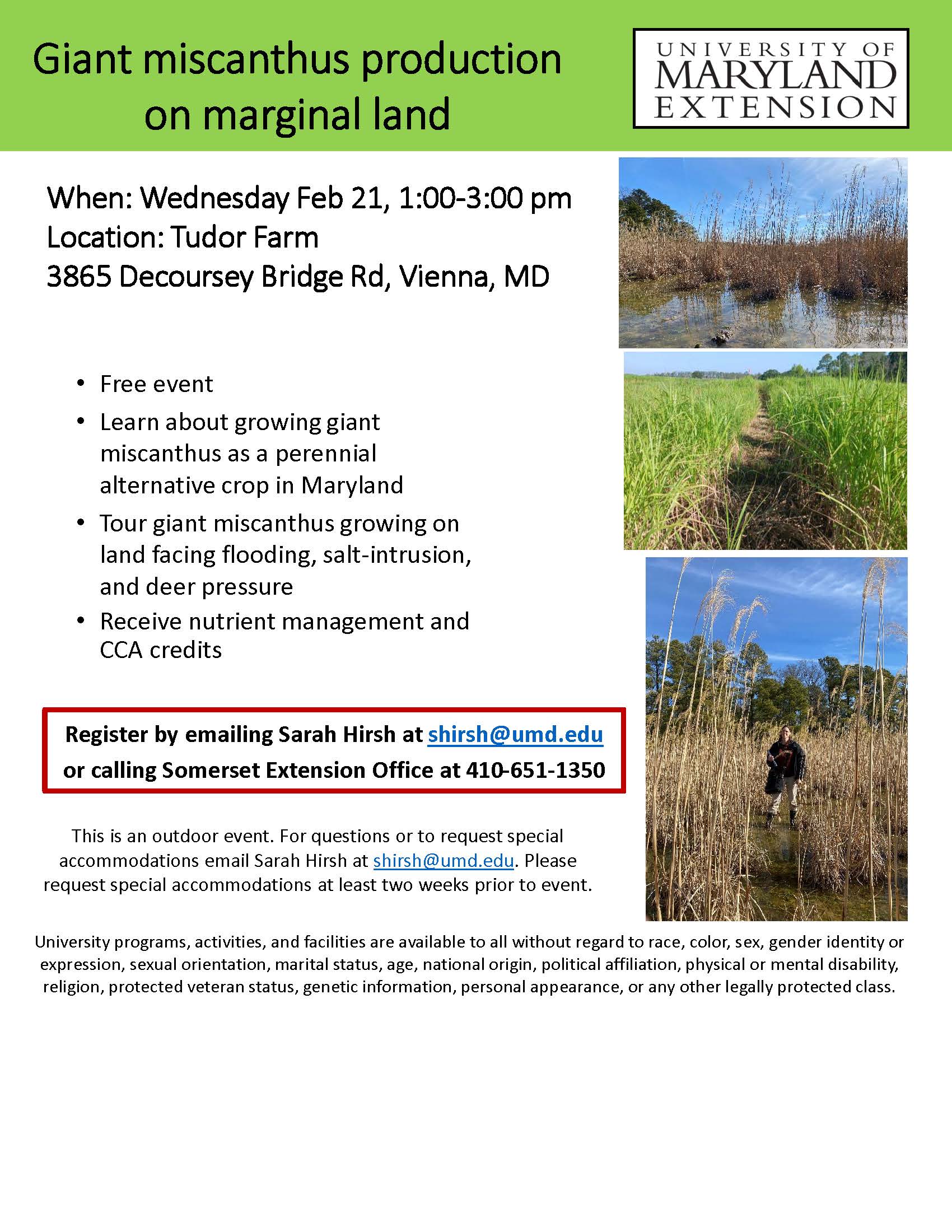
Giant Miscanthus Production on Marginal Land
- Tudor Farm
- 1:00 PM - 3:00 PM
This is an outdoor event.
Learn about giant miscanthus as a perennial alternative crop in Maryland.
This is an outdoor event.
Learn about giant miscanthus as a perennial alternative crop in Maryland.
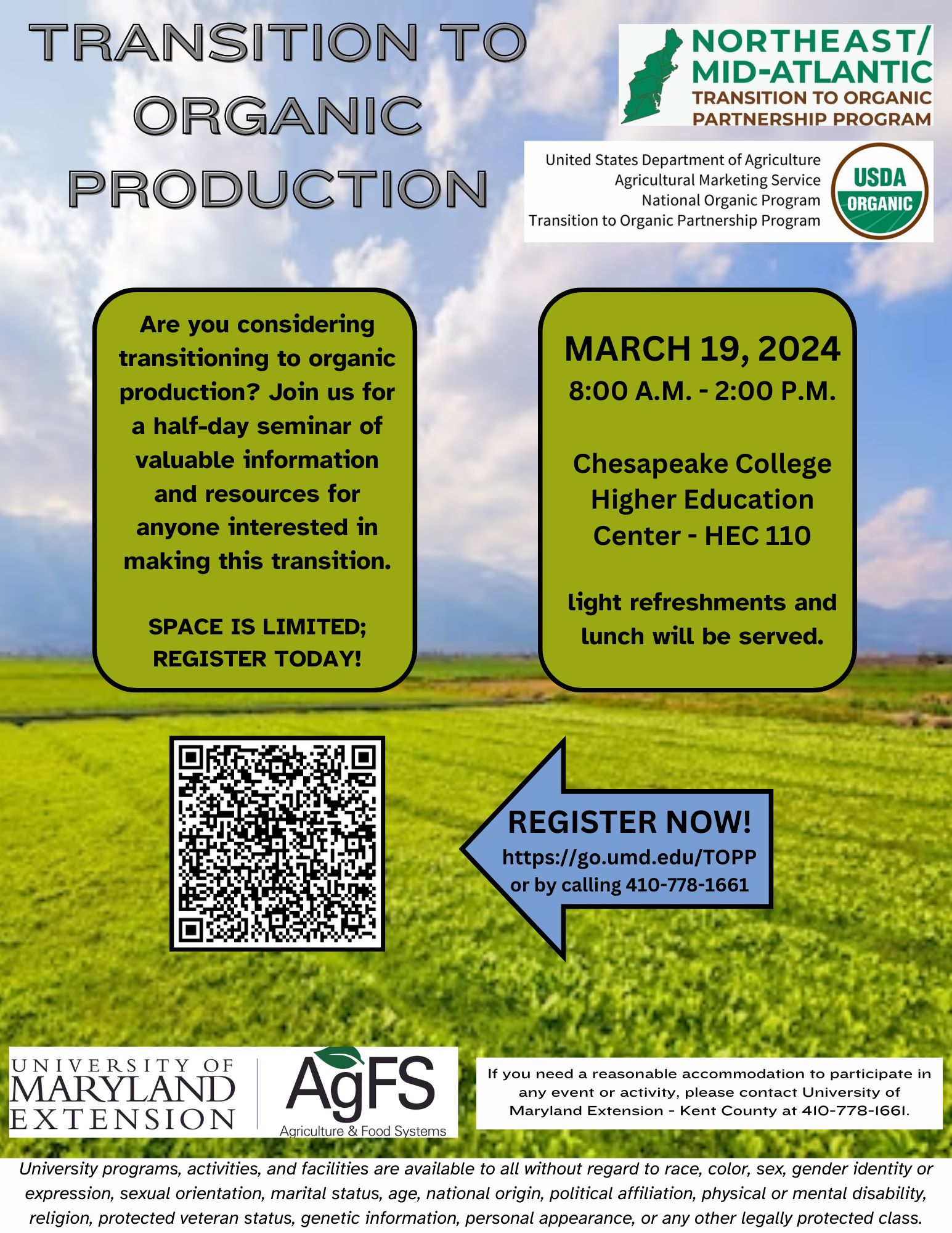
This is a free half-day seminar from 8 am to 2 pm. The agenda for the day includes presentations covering key topics such as the direction and future of organic production, insights into organic grain markets, and navigating certification, regulations, and requirements. Additionally, there will be a farmer roundtable discussion featuring panelists representing various aspects of organic farming, including grain, vegetable, animal, and research. Light breakfast refreshments and lunch will be served.
The showcase aims to highlight our students' work and experiences through posters and/or physical displays. Guests, which will include industry partners, faculty, alumni, VIPs from around campus, and UMD students, will be able to walk through the showcase to see their projects.
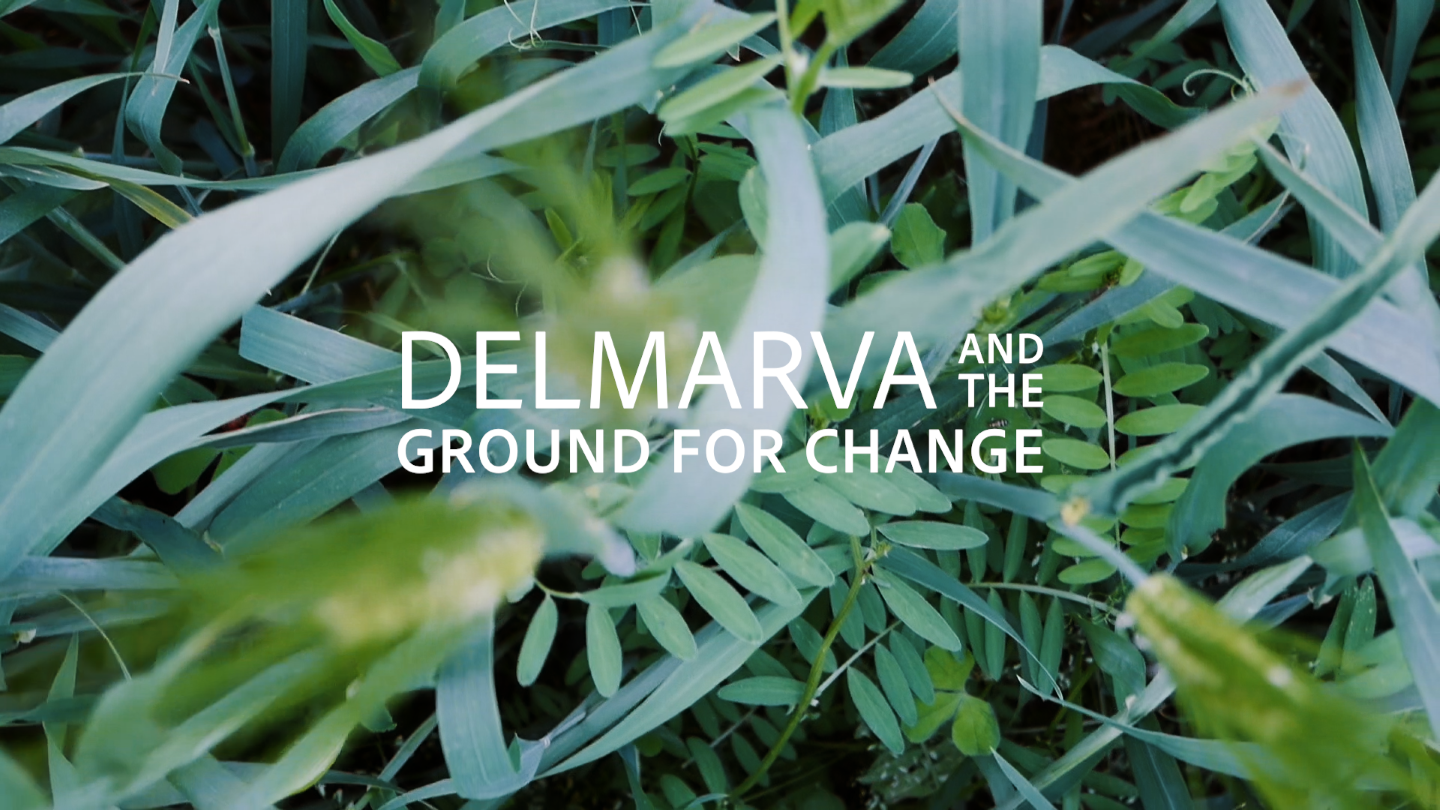
Please join us on National Ag Day for a FREE film screening of this documentary film on soil health and climate change, hosted by UMD Extension and Talbot County in conjunction with the University of Delaware. The film screening will be followed by a panel discussion with conservation and farming experts who will discuss the film and answer audience questions.
When: Tuesday, March 19, 2024, from 6pm-8pm
Where: Avalon Theatre (40 E Dover St, Easton, MD 21601)
Register: Register at: https://forms.gle/d9xzaMkTvPqYFudp9
Farmers around the Chesapeake and Delaware Bays are leaders in environmental stewardship. Many of the practices are used to protect
and promote healthy soils while also safeguarding working lands against extremes posed by climate change. This film follows three
family-owned farming operations on the Delmarva Peninsula who all care about and depend on soil.
View the trailer at: https://www.youtube.com/watch?v=J095-ClDT-k
Registration Includes:
• Course Materials (PowerPoint Slides & Handouts)
• Light breakfast & Lunch (covered by registration fee)
Who Should Attend?
Fruit and vegetable growers and others interested in learning about produce safety, the Food Safety Modernization Act (FSMA) Produce Safety Rule, Good Agricultural Practices (GAPs), and co-management of natural resources and food safety.
What to Expect at this Lab & Lecture?
The trainers will cover content related to Postharvest Handling and Sanitation.
The Lab & Lecture format involves a combination of traditional lecture-style learning (presentations with question & answer and discussion) and hands-on learning (expsoure to equipment, tools, faciities that provide practical knowledge for implementation of the lecture principles).
Attendees will have the opportunity to learn and discuss their questions with experienced professionals in the food safety realm from the University of Maryland Plant Science & Food Safety Lab, Univeristy of Maryland Extension, Virginia Tech Food Lab, the Acheson Group, Produce Safety Alliance, Food & Drug Administation, Maryland Department of Agriculture, and the Agriculture Law Education Initiaitve.
Agenda
7:30 – 8:00 am - Check-in & Breakfast
8:00 – 8:20 am - Welcome & Introduction
8:20 – 8:35 am - Regulatory Overview (Margaret Todd, Esq., ALEI)
8:35 – 9:15 am - Sanitation: Cleaning vs Sanitizing (Carol Allen, UMCP)
9:15- 9:45 am - Case Study: Harvest Equipment Outbreak (Dr. Meg Kirchner, FDA)
9:45- 10:15 am - Sanitary Design - Equipment and Tools Evaluation
10:15-10:20 am Break
10:20 -11:15 pm
11:15 - 12:00 pm - Break Out Session: Pack House Design Tour (UDC FIrebird Farm)
12:00 – 1:00 pm Lunch, provided
1:00 - 2:00 pm - Cleaning Chemistry (Dr. Laura Strawn, VTech)
2:00 – 3:00 pm - Sanitizer Chemistry (Dr. Laura Strawn, VTech)
3:00 – 3:15 pm Trivia Time
3:15 – 3:45 pm - Sanitation Verification
3:45 – 4:15 pm - Recordkeeping (UMCP/ALEI/FDA)
4:15 -4:30 pm - Developing your plan (Personal Notetaking time)
4:30- 5:00 pm - Open Discussion and Questions
Participation requirements for in-person attendees include:
• Participants are expected to complete and return course evaluations within one week of completing the course.
Funding for this series of work described in this article is supported by the Food and Drug Administration (FDA) of the U.S. Department of Health and Human Services (HHS) as part of a financial assistance award U2FFD007444 totaling $523,497 with 100 percent funded by FDA/HHS. The contents are those of the author(s) and do not necessarily represent the official views of, nor an endorsement, by FDA/HHS, or the U.S. Government.

Registration Includes:
• Course Materials (PowerPoint Slides & Handouts)
• Light breakfast & Lunch (covered by registration fee)
Who Should Attend?
Fruit and vegetable growers and others interested in learning about produce safety, the Food Safety Modernization Act (FSMA) Produce Safety Rule, Good Agricultural Practices (GAPs), and co-management of natural resources and food safety.
Psst... If you attended one of the PSR Grower Trainings in 2024, you can register for this workshop for FREE.
What to Expect at this Lab & Lecture?
The trainers will cover content related to Farm Food Safety Plan writing
The Lab & Lecture format involves a combination of traditional lecture-style learning (presentations with question & answer and discussion) and hands-on learning (expsoure to equipment, tools, faciities that provide practical knowledge for implementation of the lecture principles).
Attendees will have the opportunity to learn and discuss their questions with experienced professionals in the food safety realm from the University of Maryland Plant Science & Food Safety Lab, Univeristy of Maryland Extension, Maryland Department of Agriculture, and the Agriculture Law Education Initiaitve.
Agenda
9:30 – 10:00 am - Check-in & Refreshment
10:00 – 10:15 am - Welcome & Introduction (Margaret Todd, Esq., ALEI)
10:15 am – 12:00 pm:
Key components of a farm food safety plan
Using risk assessments to help guide food safety planning priorities (5-10 minute break)
SOPs - maintaining food safety standards – business culture & training
Practical strategies for creating effective and efficient food safety practices
Required documentation for compliance (PSR v GAP)
12:00 – 12:30 – Lunch
12:30 – 2:00 – Q&A and Individual work time with trainer assistance
Participation requirements for in-person attendees include:
• Participants are expected to complete and return course evaluations within one week of completing the course.
• Participants are expected to bring their own laptops to work on their individualized Farm Food Safety Plans. If you do not have a portable electronic device (laptop or tablet) to work on, please contact motodd@law.umaryland.edu to discuss options.
Funding for this series of work described in this article is supported by the Food and Drug Administration (FDA) of the U.S. Department of Health and Human Services (HHS) as part of a financial assistance award U2FFD007444 totaling $523,497 with 100 percent funded by FDA/HHS. The contents are those of the author(s) and do not necessarily represent the official views of, nor an endorsement, by FDA/HHS, or the U.S. Government.
Tags
Registration Includes:
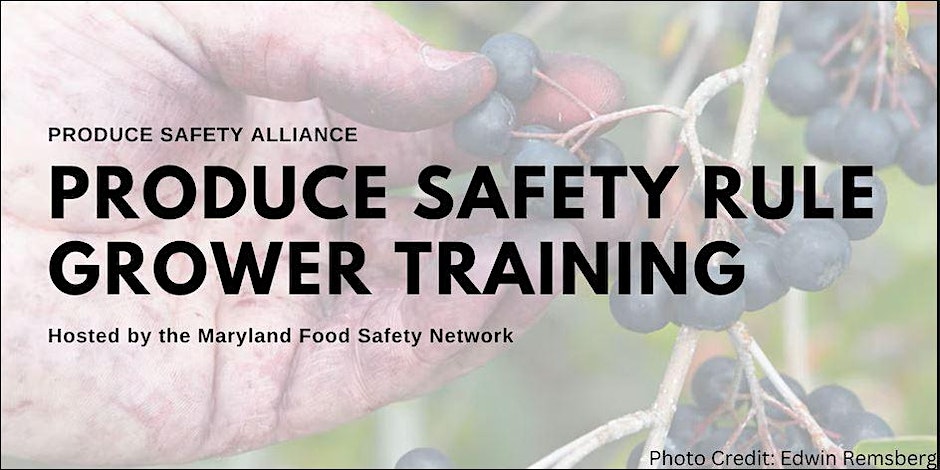
• Course Materials (Produce Safety Rule Grower Training Manual v 1.2)
• Course Certificate from the Produce Safety Alliance upon successful completion of course materials
Who Should Attend?
Fruit and vegetable growers and others interested in learning about produce safety, the Food Safety Modernization Act (FSMA) Produce Safety Rule, Good Agricultural Practices (GAPs), and co-management of natural resources and food safety. The PSA Grower Training Course is one way to satisfy the FSMA Produce Safety Rule requirement outlined in § 112.22(c) that requires
‘At least one supervisor or responsible party for your farm must have successfully completed food safety training at least equivalent to that received under standardized curriculum recognized as adequate by the Food and Drug Administration.’
What to Expect at the PSA Grower Training Course?
The trainers will cover content contained in these eight modules:
• Introduction to Produce Safety
• Role of Maryland Dept. of Agriculture and On-Farm Readiness Reviews
• Worker Health, Hygiene, and Training
• Soil Amendments
• Wildlife, Domesticated Animals, and Land Use
• Agricultural Water (Part I: Production Water; Part II: Postharvest Water)
• Postharvest Handling and Sanitation
• How to Develop a Farm Food Safety Plan
In addition to learning about produce safety best practices, key parts of the FSMA Produce Safety Rule requirements are outlined within each module. There will be time for questions and discussion, so participants should come prepared to share their experiences and produce safety questions. Appropriate time will be made for breaks at the discretion of the instructors.
Participation requirements for in-person attendees include:
• Course attendance and participation will be monitored. Any attendee who does not participate for the duration of the course will not be eligible for certification.
• A hard-copy Produce Safety Rule Grower Training Manual v1.2 will be available to each attendee prior to the course administration.
• Participants are expected to complete and return course evaluations within one week of completing the course.
Funding for this series of work described in this article is supported by the Food and Drug Administration (FDA) of the U.S. Department of Health and Human Services (HHS) as part of a financial assistance award U2FFD007444 totaling $523,497 with 100 percent funded by FDA/HHS. The contents are those of the author(s) and do not necessarily represent the official views of, nor an endorsement, by FDA/HHS, or the U.S. Government.
This course will be delivered remotely via Zoom in 2 half-day sessions:
February 6 -7, 2024 (Tuesday & Wednesday), 11:30 AM - 4:45 PM
Registration Includes:
• Course Materials (Produce Safety Rule Grower Training Manual v1.2)
• Course Certificate from the Produce Safety Alliance upon successful completion of course materials
Who Should Attend?
Fruit and vegetable growers and others interested in learning about produce safety, the Food Safety Modernization Act (FSMA) Produce Safety Rule, Good Agricultural Practices (GAPs), and co-management of natural resources and food safety. The PSA Grower Training Course is one way to satisfy the FSMA Produce Safety Rule requirement outlined in § 112.22(c) that requires ‘At least one supervisor or responsible party for your farm must have successfully completed food safety training at least equivalent to that received under standardized curriculum recognized as adequate by the Food and Drug Administration.’
What to Expect at the PSA Grower Training Course?
The trainers will cover content contained in these eight modules:
• Introduction to Produce Safety
• Role of MD Dept. of Agriculture and On-Farm Readiness Reviews
• Worker Health, Hygiene, and Training
• Soil Amendments
• Wildlife, Domesticated Animals, and Land Use
• Agricultural Water (Part I: Production Water; Part II: Postharvest Water)
• Postharvest Handling and Sanitation
• How to Develop a Farm Food Safety Plan
In addition to learning about produce safety best practices, key parts of the FSMA Produce Safety Rule requirements are outlined within each module. There will be time for questions and discussion, so participants should come prepared to share their experiences and produce safety questions. Appropriate time will be made for breaks at the discretion of the instructors.
Participation requirements for this web-based course include:
• High-speed internet connection
• Computer or other appropriate device with webcam and microphone, which must remain functional for the duration of the course, to verify participation of each attendee.
• Course attendance and participation will be monitored through chat, polling, and other engagement. Any attendee who does not participate for the duration of the course will not be eligible for certification.
• Troubleshooting is available for participants with unstable internet. Any make-up sections, due to lost internet connection etc. must be coordinated individually with the trainers.
• A hard-copy Produce Safety Rule Grower Training Manual v1.2 will be shipped to each attendee prior to the course administration. Course registration will close approximately 7 working days prior to the course to facilitate book shipment. Please be sure the shipping address you provide at the time of registration is capable of receiving packages.
• Participants are expected to complete and return course evaluations within one week of completing the course. Evaluations and a link for the training will be sent in a confirmation email prior to the training date.
Funding for this series of work described in this article is supported by the Food and Drug Administration (FDA) of the U.S. Department of Health and Human Services (HHS) as part of a financial assistance award U2FFD007444 totaling $523,497 with 100 percent funded by FDA]/HHS. The contents are those of the author(s) and do not necessarily represent the official views of, nor an endorsement, by FDA/HHS, or the U.S. Government.
The IAA offers nine majors to jump-start your career in agribusiness, sustainable agriculture, environmental stewardship, horticulture, landscaping, turfgrass management, or ag communications. We will explore areas of study, financial aid and scholarships, world-class facilities, campus life, and more!
Join us for the next installment of MomentUMD Live: AGNR Conversations Around Grand Challenges, featuring Eric Reson, Chief Programmes Officer with the Maasai Mara Wildlife Conservancies Association. This installment on Tuesday, February 13 at The Stamp will feature a dialogue on international wildlife conservancy.