
In a bright, airy greenhouse perched on the hill at the north end of campus, a revolution in teaching, learning and sustainable agriculture is coming to life. Rows of lettuce stretch toward the filtered sunlight, their roots dangling in water rich with nutrients. Below them, tilapia and bluegill swim in large blue tanks, their waste converted by beneficial bacteria into fertilizer that feeds the plants above. This is aquaponics—a system that relies on processes found in natural ecosystems—and at the University of Maryland, it’s more than just a teaching tool. It’s a living laboratory, a student-operated venture, and a launchpad for the future of food.
At the heart of the program is Dr. Jose-Luis Izursa, a senior lecturer and academic advisor in the Department of Environmental Science and Technology (ENST). Eight years ago, Izursa had a vision: to build a space where students could get their hands dirty (and wet), not only learning about sustainability, biology, and engineering, but actually conducting experiments and driving innovation in real-time. Today, that vision has grown into a fully fledged aquaponics program that produces leafy greens, herbs, ornamental goldfish, tilapia and bluegill while also hosting serious research on things like nutrient cycling and food safety.
Aquaponics is an increasingly popular method for growing food that can be done just about anywhere,” said Izursa. “It can live in warehouses, basements, or on the roof of a city building, and the students love it.”
Learning by Doing
The idea of aquaponics first came to Izursa in 2017, as he was searching for classroom subjects and activities that would resonate with students. “I was teaching ecological design, and one idea I proposed to my students was this aquaponics demonstration system,” he recalled, in his characteristic soft voice and rhythmic Bolivian accent. “When they put it in [the design program] Autocad, I saw their fascination. They loved it, and that sort of started the whole thing.”
Two 50-gallon barrels, a few dozen fish and some seedlings was all it took to get the ball rolling. Then, Izursa introduced aquaponic systems as potential ENST capstone projects where seniors could integrate and apply what they’d learned to building a real, working system. The interest was tremendous. Over three capstone classes, students rotated through the process of designing, redesigning, and improving on a single, portable demonstration unit they now call the Mobile Aquaponic Teaching Assistant (MATA).
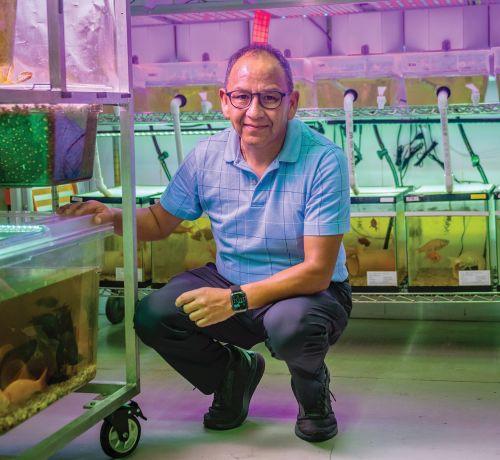
But they didn’t stop there. Within a few short years, Izursa had a whole laboratory in the environmental science and technology building complete with two dozen 10-gallon aquariums, grow beds and grow lights supporting goldfish and a verdant crop of lettuce and basil. Both MATA and the lab are still important parts of the aquaponics program where student researchers can run multiple treatments on different tanks and easily replicate their studies in a controlled environment.
“This lab is pretty unique,” said Hibba Hussain (BS 2021) a master’s student who works in the lab. “People think of your typical bio and chemistry labs with goggles and glass vials, but here, it's like a mixture of everything, engineering, biochem, microbio, live plants and animals.”
Hussain was one of those early capstone students who joined the aquaponics lab in her senior year. She stayed on as a part time lab technician after graduation and it launched her into her master’s program. She’s been conducting research while helping build the lab into what it is today.
“All the systems we've created from scratch,” she explained. “We’ve changed the design so many times, I cannot tell you.”
An aquaponics cycle is simple in principle: Nutrientrich wastewater is pumped from a fish tank into a series of filters, where “good” bacteria break down ammonia into nitrates, which fertilize the plants.
As they take up the nitrates, the plants “clean” the water and “breathe” oxygen into it before it is pumped back into the fish tank. The only input needed is food for the fish, electricity for the water pumps, and light for the plants.
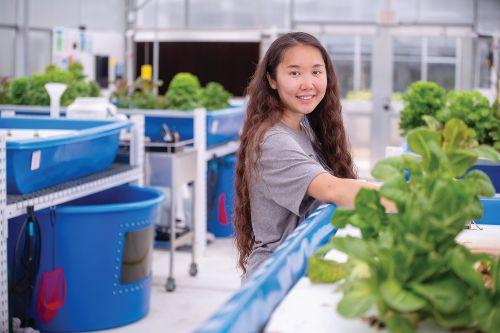
Making the system work automatically, however, is not as easy as it sounds. It requires a bit of understanding of plumbing, electronics, chemistry, mechanical engineering, and a handy man’s knack for tinkering until something works. Hussain rattled off a list of things she and other students had to learn as they went along, from what kind of plastic bins worked best for grow beds to the pump size required to properly work the filtration system. All the while, students were aware that living plants and animals depended on them getting it right.
Scaling Up
As the lab in ENST grew, so did Izursa’s vision. He wanted to develop a larger facility that could simulate a commercial-scale operation with bigger tanks, and fish that could be used for food. He had his sights on an empty patch of land beside the existing greenhouses at the Research Greenhouse Facility.
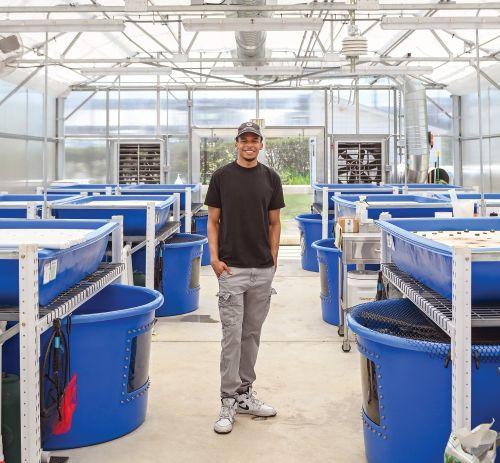
“I had no idea what I was getting into,” Izursa chuckled with a wry smile. “I thought it would take maybe $36,000.” $200,000 later, the new facility is a 1,200-square-foot feat of sheer determination where he and his students maintain six 210-gallon fish tanks and 216 square feet of harvestable crop area. Izursa worked tirelessly to find support to build out his ideas, receiving funds from AGNR as well as the UMD Office of Sustainability, the Student Facilities Fund, and the Shinobi Group, which supported the climate control technology. Meanwhile, students flocked to his fledgling program, and by the spring 2023 semester, he had started a course dedicated to aquaponics.
“The completion of the greenhouse is super exciting,” said ENST Chair Paul Leisnham. “The whole project has been a game-changer for student learning and education that brings environmental or "green" engineering to life. Our students now have the opportunity to engage directly with a living system where biology, engineering, and sustainability intersect.”
Just like in the lab, the students have always been at the heart of the greenhouse project, learning side-byside with Izursa. Since the beginning, he has relied on a student greenhouse manager, student research technicians, and interns, including high school students who have spent the summer learning about aquaponics while they help maintain the systems.
Feeding the Campus—and Beyond
Aquaponics is, at its core, a farming system, and even a teaching and research system produces pounds of nutritious leafy greens and fish. So, when they’re not doing experiments on the produce, the students donate their harvest to the campus food pantry for distributions to their friends and peers experiencing food insecurity.
The potential to help solve issues of food security and access to protein and fresh vegetables in a variety of environments, from cities and food deserts to real deserts is one of the most appealing aspects of aquaponics, propelling the industry’s growth around the world. It uses only a small fraction of the water of traditional agriculture—making it especially valuable in water‑scarce regions. By enabling year‑round production of both fish and a wide array of crops close to where they’re consumed, aquaponics systems reduce dependence on long supply chains and help communities build resilience against climate disruptions and food deserts.
“It’s never going to replace traditional agriculture,” Izursa said. “It would be crazy to think we’d grow wheat or corn this way. But the beauty is that you can put a greenhouse like this anywhere, and it changes the question of who has access to fresh food.”
On campus, the students appreciate the connection between the work they do and the lab’s contribution to nourishing their community. For Izursa, community impact is not an accidental side benefit. It’s a deeply rooted value that reaches back through the generations. He grew up playing with Rotary Club Stickers from his grandfather and watching his father host the club meetings in their family restaurant. He’s followed in that tradition, joining the local Rotary soon after moving to College Park and even serving as president in 2021. On campus, he’s equally involved in community leadership and was named the first chair of the UMD Latinx Employee Association.
With his tendency to become invested in community, it’s not surprising that Izursa’s dedication to aquaponics would propel him into a prominent role in the global Aquaponics Society. Through the process of building out the greenhouse facility, he has developed a network of colleagues in academia and private industry, and this September, he will welcome them to the UMD campus as the host of the 2025 annual meeting.
Interdisciplinary by Design
Although the aquaponics program lives in the College of Agriculture and Natural Resources, it is by nature interdisciplinary. Students from engineering, biology, environmental science, and even business and education participate.
That was one of the attractions for Hussain, who minored in nanoscience and nanotechnology as an undergrad. “I joined Dr. Izursa’s Lab specifically because I wanted to study nanobubbles,” she said.
Nanobubbles are so tiny they can’t be seen in water by the naked eye. They are used in wastewater treatment plants to purify water, and some agricultural systems also use them. But their potential uses in aquaponic systems is unclear. “The studies out there have mixed results,” Hussain said. “They increase the productivity of some crops, but others like carrots, they don’t grow well with nanobubbles.”
She suspects the bubbles may interrupt the bacteria in the system, but no one knows for sure, and after studying their impacts on water chemistry and plant growth, she is considering going for her PhD to answer questions about the mechanisms involved in how nanobubbles affect these systems.
“That’s getting into the DNA and RNA, and looking at the molecular interactions,” she said. “There’s just so much you can do here,” Hussain said. “When I talk with undergraduates, I tell them, whatever you're interested in, you'll be able to find in this lab.”
That is surely reflected in the diversity of students Izursa has mentored in his program. They include students from other colleges on campus and universities around the world. And just like the students learning to build the systems in the ENST laboratory, those working in the greenhouse are stretching their horizons to learn much more than their core discipline.
“I have lab experience in water quality, working in GIS, and modeling, but what is unique here is I am dealing with a whole system,” said Gibbeum Choi, who has been managing the aquaponics greenhouse since the spring. She came to UMD after earning her bachelor’s degree in environmental science in South Korea.
“It’s a very self-contained system, and everyone has to know how to deal with all of it,” she said. “We have our tasks for daily husbandry, but if an unexpected issue happens, you have to solve it or call someone. You can’t just leave it. These are living things.”
This is the first time Choi has worked with live plants and animals, and she said the whole experience will be valuable no matter what direction her career path takes. It not only exposed her to the different disciplines involved in aquaponics, but keeping the systems running requires a level of teamwork and communications that is hard to experience in other research and internship experiences.
A Living Lab with Lasting Impact
Izursa and his students are still working out many of the details in the greenhouse system, such as which fish and vegetable species grow best, and whether they can produce crops like peppers and zucchini. Izursa is also talking about using solar to power the system and he wants to experiment with soldier fly larva as a potential fish food. The larva could offer high protein nutrition to replace traditional fish food, which is considered less environmentally sustainable. And Choi is interested in exploring whether the unwanted algae that needs to be cleaned off the system can be used to supplement the fish food.
In the controlled chaos of the aquaponics greenhouse, where the sounds of water burbling and pumps humming are constant, it’s clear that something remarkable is happening.
Students are learning by doing, innovating by failing forward, and growing not just crops but confidence, competence, and community.
“Aquaponics represents the future of agriculture—closed loop systems that conserve water, reduce waste, and produce food sustainably,” Leisnham said. “What Dr. Izursa and his team have accomplished in building the aquaponics greenhouse is awesome. It’s the result of years of passion, vision, persistence, and hard work.”
And in the process, they’re proving that sustainable agriculture isn’t just a topic for textbooks. It’s a hands-on, collaborative, dynamic field—one that has room for all kinds of learners, thinkers, and doers. Thanks to one professor’s vision and a team of passionate students, the future of sustainable farming is being shaped right here, one tank, one leaf, and one bright idea at a time.
by Kimbra Cutlip