University of Maryland Graduate Student Contributes to Study that Could Return American Chestnut to Maryland Forests.
Greenhouse full of chestnut seedlings.
Image Credit: Courtesy of The American Chestnut Foundation.
For more than a century, the American chestnut, once a dominant tree across eastern North American forests, has been devastated by an invasive fungal disease that killed billions of trees in the early 1900s. A new study published in the journal Science shows that modern genomic tools can dramatically accelerate restoration while preserving the species’ ecological identity.
University of Maryland graduate student Bruce Levine was among the authors of the study, which demonstrated that researchers could identify disease resistance in chestnut trees through DNA data alone. This information will allow breeders to identify disease resistant seedlings through their genetics and speed the process of restoration by shortcutting years of field testing on slow-growing trees.
“This paper draws attention to the progress being made toward chestnut restoration as a result of what we have learned from our efforts up to now,” said Levine, who works under Plant Science Professor Shunyuan Xiao of University of Maryland College of Agriculture and Natural Resources and the Institute for Bioscience and Biotechnology Research (IBBR). “The American Chestnut Foundation’s recurrent genomic selection program is moving us in the right direction, but the paper also shows the potential to accelerate our progress through other lines of research.”
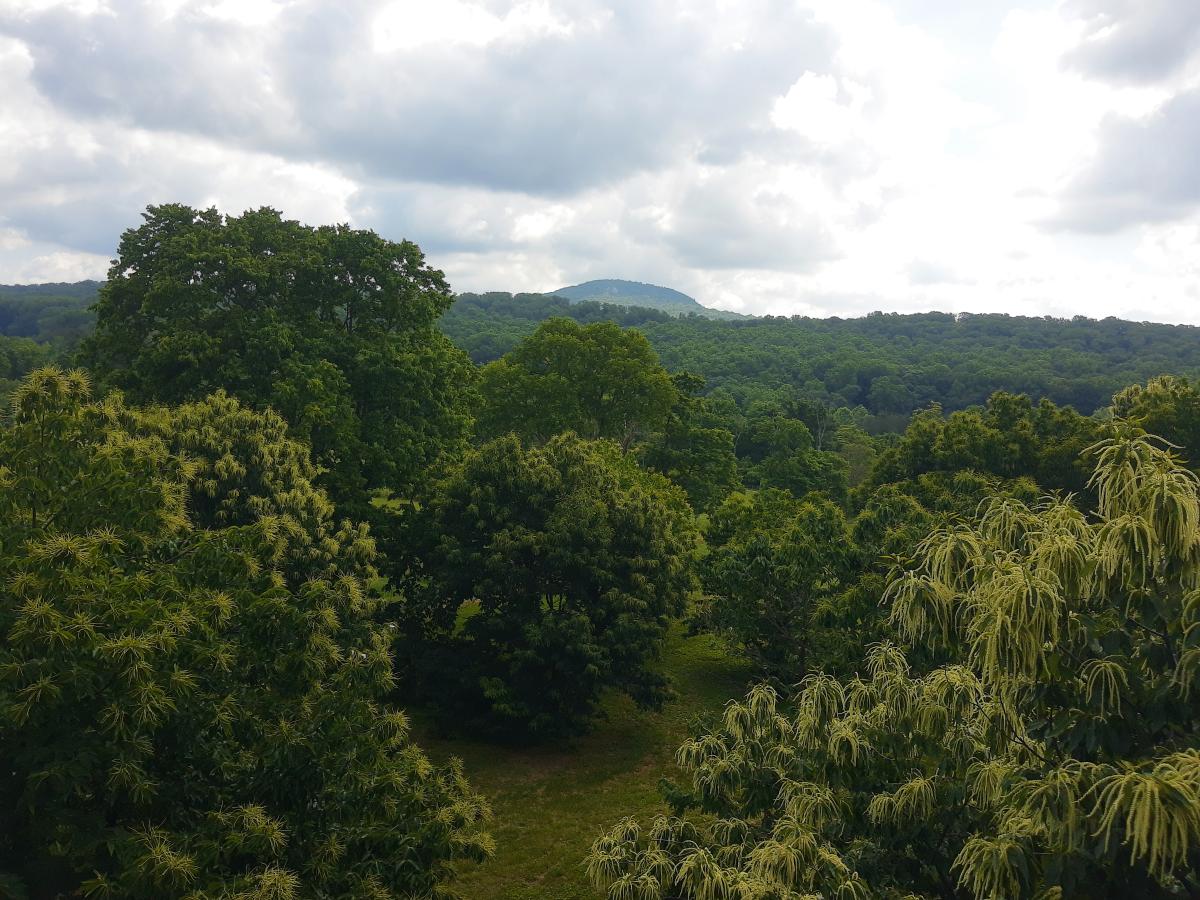
Prior to 1900, giant centuries old American chestnut trees dominated the forests in the eastern United States. However, in 1904, a parasitic fungus hitched a ride to the U.S. on chestnut trees imported from Asia, initiating the chestnut blight pandemic and rendering the American chestnut functionally extinct in its native range by 1950. For over 100 years, scientists have been exploring ways to restore this foundation species to improve forest health, bring back food sources for people and wildlife, revive a once-important chestnut timber industry, and increase carbon sequestration. As part of these efforts, Levine studies genes in the fungus associated with the disease, and is active with The American Chestnut Foundation’s (TACF) breeding program in Maryland.
One of the strategies researchers have been using in their attempts to restore the American chestnut to its native range has been to breed American chestnuts with Asian relatives that naturally resist the fungus. The central challenge has been balancing beneficial traits: Asian chestnuts evolved alongside the fungus and carry natural resistance, but tend to grow shorter. American chestnuts grow tall and fast – traits critical to their role in forest ecosystems – but remain highly susceptible to blight.
By combining genomic sequence data with long-term blight resistance data among thousands of hybrid chestnut trees from TACF’s breeding population, the study authors showed that resistance can be reliably predicted from genetic data. This enables the Foundation’s breeding program to retain high American chestnut ancestry while steadily improving blight resistance.
“With genome-enabled breeding, we expect the next generation of trees to have roughly twice the average blight resistance of our current population, with about 75 percent American chestnut ancestry,” said lead author Dr. Jared Westbrook, TACF’s director of science. “These trees are expected to begin producing large quantities of seed for restoration within the next decade.”
According to Levine, the study has implications beyond just American chestnut trees, offering methodologies that could help protect or restore other native plants facing novel pathogens as a consequence of globalization.
The study, “Genomic Approaches to Accelerate American Chestnut Restoration” was published on February 12, 2026, in the journal Science.
Levine’s work is funded by The American Chestnut Foundation (TACF), and outside the University he is active in TACF’s chestnut breeding program in Maryland.
Portions of this story were adapted from text provided by The American Chestnut Foundation.
